
Learning To Say No Without Guilt (EP 114)
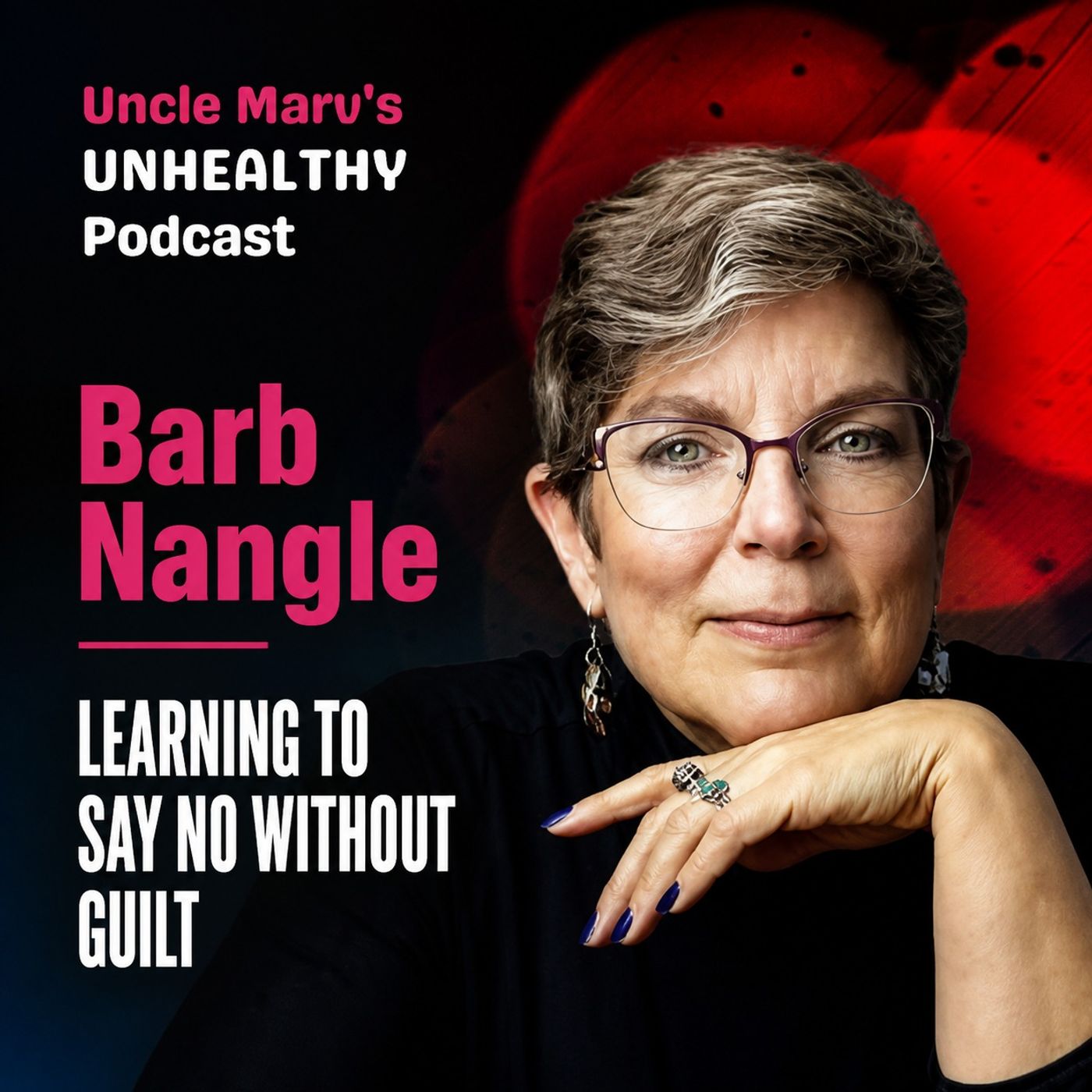
Barb Nangle is back to unpack how real boundaries create internal safety, cut burnout, and help you stop abandoning yourself. We talk about learning to say no without guilt, and how that shift ripples through work, relationships, and recovery.


This conversation picks up right where part one left off, but now we zoom in on Barb’s actual work helping overwhelmed professional women who say yes when they want to say no. She breaks down “internal safety” as the ability to have your own back when someone is upset with you or when that old guilt and negative self-talk shows up, instead of caving or beating yourself up for weeks. Barb drives home that boundaries aren’t about controlling other people, they’re about deciding what you will do and following through, even when it’s uncomfortable.
We also get into people‑pleasing, codependency, perfectionism, and the burnout that shows up when you’re constantly pouring from an empty cup. Barb shares how she built self‑worth, self‑love, and self‑trust one decision and one boundary at a time, plus how reparenting work helped her “backfill” the love she didn’t get as a kid. She lays out practical first steps: starting with a boundary on your own self‑talk, practicing with easygoing people, and learning that discomfort doesn’t automatically mean danger. By the end, we’re talking Hallmark movies, Pellegrino with lemon, and how recovery even changes your taste buds.
=== Chapters
- 00:32 Part Two Begins
- 02:44 Boundaries Coaching Defined
- 05:48 What Internal Safety Means
- 14:47 Women, Burnout, and Self-Priority
- 18:51 Safety Comes From Within
- 23:19 Boundaries Prevent Burnout
- 27:54 Start With Self-Boundaries
- 31:12 Real Boundaries, Real Consequences
- 34:33 Discomfort Is Not Danger
- 41:13 Recovery Joys and Guilty Pleasures
- 44:47 Course on Internal Safety
=== Guest: Barb Nangle, Higher Power Coaching & Consulting
- Website: https://higherpowercc.com
- LinkedIn: https://www.linkedin.com/in/barbnangle
- Instagram: https://www.instagram.com/higherpowercoaching
=== Resources / Companies / Books / Podcasts
- Fragmented to Whole: (Podcast): https://higherpowercc.com/podcast/
- Boundaries That Hold: How to Stop Overriding Yourself in Real Time (Course): https://higherpowercc.com/boundariesthathold
- Alcoholics Anonymous (AA) / Overeaters: https://www.aa.org
- Adult Children of Alcoholics / Dysfunctional Families (ACA): https://adultchildren.org
- Pellegrino (San Pellegrino Sparkling Water): https://amzn.to/4hqvfCE
- Hallmark Channel: https://www.hallmarkchannel.com
- Lifetime (TV Network): https://www.mylifetime.com
=== About the Unhealthy Podcast
Hosted by Marvin Bee (Uncle Marv), the Unhealthy Podcast dives into real conversations about health, wellness, and everyday habits that impact how we live, work, and age. From nutrition myths to stress management and tech-life balance, Uncle Marv brings humor, insight, and honesty to every episode.
- Visit our website: https://www.unhealthypodcast.com/
- Connect on Facebook: https://www.facebook.com/iamunclemarv
- Connect on LinkedIn: https://www.linkedin.com/in/marvinbee/
Follow and Subscribe: Stay updated with new episodes every week on Apple Podcasts, Spotify, YouTube, and more. Join the conversation about real-life health, fitness, and personal growth from the lens of an everyday guy striving to be healthier.
[0:15] Hello friends, Uncle Marv here with another episode of the Unhealthy Podcast, the show where we do our best to talk as openly and as honestly as we can about
[0:28] the habits, stories, and patterns that are in our lives that we'd like to fix. So welcome back. And if you caught the last episode, that is part one with Barb Nangle, you heard the story behind her own unhealthy patterns and, not only how they showed up in relationships, but how recovery and years of work helped her to rebuild from the inside out. So here we are in part two, and I'm going to try to do my best to shift from, Barb's history to her work today as a boundaries coach. Barb, welcome back. Thank you so much. I'm excited to continue this conversation. Yes, and we did have some off-air talk and we shared a little bit. I told you a little bit about a little bit of where I may have had some.
[1:17] Some boundary issues myself growing up. So I mean, I think everybody does. It's just when you grow up with intergenerational family dysfunction and childhood trauma, it's very hard to have boundaries because it's just not safe or you don't perceive it to be safe. And then you develop patterns in your childhood and they just get more entrenched over time. Unless you do something drastic to change them. Yeah.
[1:47] Before we get too far in, I do want to make sure that I mentioned, I know we mentioned your podcast last time and people, of course, if they pay attention to the show notes, they can find the Fragmented to Whole podcast. And we did quickly mention your website. I want to mention it on air. It is highpowercc.com. Higher power cc.com higher so it stands for higher power coaching and consulting that's why it's there we go higher power cc i should have had my glasses on i knew that, higher power cc.com and there they can uh look at all your work there you are a coach speaker podcaster and author so, Let's do this without going back and talking about the history and how you got to what you're doing.
[2:44] Tell us about what it is that you do and how you went from learning about yourself to feeling like you needed to then share with others.
[2:55] So I am a boundaries coach. And the way I talk about my ideal clients are they're professional women who say yes when they really want to say no. And they neglect themselves because they're so focused on others. So what I do is work with overwhelmed professional women to help them build internal safety, so they can set boundaries and limits without guilt and shame and also stop focusing so much on what other people think. So of course I work with people who don't identify as professional women, but because I'm a professional woman, it just made sense for me. And, you know, I mentioned the impact that building boundaries had on, my work life, that I know that, you know, whether you come to me for boundaries in your romantic relationships, personal relationships with your adult children, in the workplace, whatever it is, that especially if you're a professional, it's going to have an impact, on your work life. And I think that the more women who stop saying yes to things they don't want to do and stop neglecting themselves, the more women we're going to have rise up into the power structures of society. And I am of the belief that that is needed.
[4:15] So I, I, I get that and understand we have in my industry, which is the tech industry, there is this mindset that if you're not, this geeky kid in your mom's basement playing games or stuff like that, if you're, you know, of a certain minority or a female that you're not going to get it. And I know that there are women in tech groups where they try to do that themselves and empower themselves in a world of the male-dominated tech space. So let me ask real quick, and then we'll get right back to it. Your emphasis is on professional women. Is there ever a time that you talk to professional men and help us understand how we're not helping? So not men exclusively. I've absolutely done talks, presentations, and workshops that are men and women. But I've never specifically targeted men and I would do private coaching with a man but I wouldn't do group coaching with men.
[5:22] Because the you know the people that follow me because I cater towards women it doesn't mean I have anything against men but I've lived the woman experience so that's what I really want to talk about that's fine and I'm in recovery with lots of men who have horrendous boundaries, you know, and our codependent AF, you know, so it's not something that's exclusive to women by any means. It's just, this is what I choose to do. Okay.
[5:49] So now getting back to what you do and this concept of internal safety.
[5:55] I just want to frame it properly because again, just like we did with codependency and boundaries and thinking that it's, you know, drug related, alcohol related and stuff like that internal safety, it sounds like it would be that fear of, abuse or you know whether it's mental or physical in that sense but, i get the sense that this is not specifically that this is not about you know extreme abuse but this is about protecting, like what you said that professional woman who wants to be able to excel and be free.
[6:37] Am I understanding that correct, or what's the better way to frame internal safety? Yeah, I think the best way to describe it is save an example, but because you mentioned physical abuse, I just was on a podcast a couple days ago specifically for women who are victims of domestic violence, and we talked about, whether you were codependent or not when you got into that relationship, you are by the time, because the abuser basically turns you into a codependent because they socially erode your social network, your self-esteem and all that stuff. And because this is such an important issue, I don't want to gloss over that. And what I was saying there is like, get out, get help, and then work on your codependence. It's not something to be working on while you're in the relationship. You don't need to start asserting boundaries when your life is at stake or the lives of your children are at stake. But the way that I would describe internal safety is that it's the understanding that no matter how upset someone gets with me, for setting a boundary with them or whatever else they get upset with, or no matter how much negative self-talk comes in, like, let's say I set a boundary with you, Marv, and you're even fine with it, but I still feel guilty.
[7:53] I don't let that person being upset And I don't let my feelings of guilt determine what I do next.
[8:01] When I do that, when I let you being upset with me or someone else being upset with me or my internal talk about guilt, rule my life, which is what I did my whole life, I don't have a sense of internal safety and I would call that self-abandonment. So instead of following through for myself on the boundary that I set, I cave. Or maybe I said it, I don't cave, but then I beat myself up for three weeks afterwards. words. When you have internal safety, you don't continue to do that. And internal safety is something that I actually had this realization last year. And I think actually it happened while I was the guest on a podcast where I was like, oh my God, building healthy boundaries is about building a sense of internal safety. And as soon as I named it, I realized this is something that I've been experiencing and sort of talking around for a long time. But once I named it, It helped me to retroactively understand everything that I've been teaching and living and experiencing in a whole new way. So the idea is that internal safety does not mean I am calm all the time and I never get upset.
[9:17] What it means is that I have my own back, When I get upset or when someone else gets upset with me So many people who are like me, codependent Someone else being upset with you is like the worst thing ever For me.
[9:34] I needed to be a super dependable, reliable person And I can remember, I didn't even put this together for years Years and years ago when coaching just started really coming out I met this guy who was a coach, and I couldn't afford to pay for his services. So I agreed to barter with him. I was going to do clerical work. And I, this one week, I didn't do the things that I said I was going to do. And I was hysterical. And he was this is back when like cell phones were not around, but he had a car phone and he said to me, all right, Barbara, just I'm in the car. I've just pulled into my driveway. I'm going to hang up and go in the house and call you while I'm transitioning. I want you to go in your bathroom and I want you to look yourself in the mirror and I want to ask yourself, why are you this upset? Because this is way out of proportion. And it was about the fact that I wasn't reliable. I was so identified as someone who can be depended on that I just lost it.
[10:35] And I couldn't make any sense of it back then. Now I know it was like, oh, it was my identity and I wasn't living up to it. And I was completely like I wasn't relying on like I wasn't reliable to someone else. How could I live with myself? I mean, I acted like I murdered someone, you know, it was crazy. And now I can see that as related to, you know, the dysfunction in this identity. Like I'm there for other people when I say that I'm going to be there. Now, I don't remember what the reason was, but I'm sure it wasn't. I didn't feel like it. You know, I can't remember why I didn't do it. But now I am much more focused on who I am being over what I am doing So am I being a woman of integrity? So I'm a woman of integrity, which means most of the time I do what I say that I'm going to do But if I don't, I have a really good reason and I tell you.
[11:36] As soon as I possibly can, this isn't going to work out. Or, you know, I need some more time. Or, you know, I didn't get as much finished as I wanted, but let's take a look at what I've done so far. You know, and I don't look at it like I'm a horrendous human being, which is what I used to do. And, you know, I know that I said this, I think I said it in between calls, that I've always been a very positive, optimistic person. I always felt like a powerful woman of agency, even before I got into recovery. And when I got in recovery, I realized, number one, I did an enormous amount of catastrophizing and ruminating. I did a lot of complaining. I did a lot of blaming. That's all negativity. I didn't even understand that. And I also was not making choices in my life in ways that a powerful woman of agency would make so I had this idea about myself that was just not living up to, how I was living and so I came to see that.
[12:37] I think I liked myself I think I had decent self-esteem but I could see I didn't have self-worth, I did not love myself and I knew I did not trust myself I definitely didn't and I now I really, truly love myself. I feel very worthy and I do trust myself. And when I look back, like what was the process that got me to build self-worth, self-love and self-trust? Frankly, it was the boundary building process because building boundaries is about getting to know yourself and then acting on that knowledge and following through. So I built self-trust one decision at a time, one boundary at a time by stopping, you know, sabotaging myself, stopping abandoning myself by building my internal safety. And when I looked back at my behavior before recovery, I was like, that is not the behavior of a woman who feels worthy. And now I do.
[13:40] And I truly love myself. And that, I would say, you know, has to, like, you know, if you have a person in your life and you start treating them really well and taking care of them and following through for them, they're probably going to love you. Well, guess what? I did all that for me. So it's pretty easy to love me. And then, I don't know if we want to get into this or not, but a lot of the self-love also came from my reparenting work. So in my ACA program, in our fellowship literature, there's a phrase in there that says we can backfill the love that we didn't get as children. And I cannot tell you how much I love that notion. That I can and my parents loved me don't get me wrong but they also didn't know how to parent right because they weren't parented well it's intergenerational stuff yeah so well before we before we go before we go down that road I want to go back because I don't want to lose the thoughts that I have when you went through understanding.
[14:47] The changes that you needed to do with your boundaries and your feelings of guilt when not doing what you said you were going to do, is that a place that is hard for most women? Because part of me, I hear what you're saying, and I think in my mind, I'm thinking there's a lot of women that are like that, where their entire mindset is on making sure that.
[15:15] Everything's taken care of taking care of other people first that there is this, this dependability issue that they have to be.
[15:26] And it almost sounds like there's a little bit of codependency there in in all of that so is that kind of what you need to break through first when you're talking to people.
[15:37] Well i think it's people i don't think it's just women i think it's worse for women because of patriarchy, because women are acculturated, like you're supposed to be a good girl and you're supposed to be kind and helpful and put other people first. And when you grow up, if you're going to be a mom, you need to be a super mom and you're going to be in charge of the family. And like, we get these messages from everywhere, not just from our families. And I know like, if you call a woman selfish, Marv, it's like calling her a swear word. It's like, I had a client who said to me, Barb, frankly, I'd rather be called a whore than selfish. I was like, whoa, what is happening in our society that a woman says that? You know, like what is going on? And if you want to put a woman in her place, call her selfish. And so like for a lot of women, you don't even need to say that to them because they're going to think it on their own. Like, oh, how dare I be selfish and try to put my needs first? And, you know, one of the things that I've learned and that I love this notion of you can't pour from an empty cup, what you want to do is pour from the overflow. And the only way you can have overflow in your cup is if you fill it first. No one else is going to come up to you and fill your cup. And so what fills my cup might not be the same as what fills other people's cup. For me, it's things like prayer, meditation, relaxation, reading, physical exercise, yoga, spending time with loved ones.
[17:04] Things that fuel me so as you start building healthy boundaries you start to learn I get to reduce things that drain me and increase things that fuel me it's not selfish and you know when you think about.
[17:19] You know for folks who've ever flown on an airplane you know what they say if the oxygen mask falls down and if you're caring for someone next to you put the mask on yourself first because if you are passed out, you can't help the other person. It's not selfish to put the mask on yourself first. It's selfless because you can't be helpful to those around you. And if you're pouring from the overflow, what you give to people is going to be so much better and more. And to give a concrete example from my own life, I volunteered for something like 13 different nonprofit organizations before I got into recovery. And I thought of myself as a volunteeraholic back then. When I got into recovery, I was like, that's it. I'm done volunteering for anything but me. And now I've volunteered for, I think, four different more organizations since then. But I donate more hours per week in community service now than I ever did before. But I do it strategically rather than at the drop of a hat. I do it by choice, not out of some obligation or some compulsion. Like, if not me, then you. If not now, then when? Because I said that all the time. And I do it after filling my cup first. So learning how to build healthy boundaries and putting yourself first does not mean you're going to be unhelpful, that you're going to be mean, that you're going to put up walls.
[18:44] It means you're going to fill your cup first and pour from the overflow.
[18:51] Gotcha. Okay, before we go back to where you were going with the reparenting, I want to also go back to, when you realized that you had the aha moment about calling it internal safety. Mm-hmm, mm-hmm, mm-hmm. Do you have the frame of thought that you were in when you had that in turning, you know, this concept in protecting boundaries and framing it internal safety i mean, because part of me is trying to understand you know there's a blindness that we have.
[19:37] When it comes to those boundaries as well as internal safety so I m trying to i just want to get the yeah the essence of what you what you found out there, yeah so I m going to answer it this way. So what most people do is they go to the outside world for a sense of safety, whether it's I need people's approval to feel safe, I need to have a certain type of car, live in a certain neighborhood, carry a certain kind of pocketbook, have a certain title. That's like people are just striving for something because most of us, what we ultimately all want is to feel safe. And for humans, we're wired for connection. And the worst thing you can do to a human is ostracize them. So to feel safe as a human is to feel like I belong. People are not going to reject me. They're not going to judge me. They're not going to ridicule me. They're not going to abandon me. That's what makes me feel safe. So we go to the outside world for that. The problem is there are 8 billion people. You cannot make everyone else okay with you. You just can't, right? So you get to be okay with you. And so what we're doing when we do all that As we're going out to the outside world to feel safe, well, when I'm telling you I want you to have internal safety and I can, you know, I know how to get you there, I'm saying you can't create internal safety by focusing externally.
[21:03] When you are constantly people-pleasing, fixing, rescuing, enabling, being codependent, you are completely ignoring yourself and what's happening inside of your body, in your mind.
[21:18] There was so much of me that was up for negotiation. I think a way a lot of people describe it is I was a chameleon, and I was proud of it. I felt like, oh, I can fit anywhere. No, you can't. You can't fit in anywhere. Because if you're not being the real you, you're not actually fitting in. I had all these different masks and facades up all the time. So in my head, because I remember myself in school where I was a part of every club, every sport, and I got it, and I would take that even a step further.
[21:58] You can fit in anywhere, but you can't fit in everywhere. Does that make sense? No, I feel like I'd have to ponder that. Okay. I feel like on the face of it, I'm like, I don't know. I don't know. Well, because at any given point in time, yes, you can do this thing at this time and then you can switch, but you can't, you can't do it all at the same time. You can't be everywhere at once. Right. But are you compromising yourself, you know, in those different places? So this isn't a club, but this is an example. So in my drinking days, which was most of them, you know, as an adult, when I was young, I started drinking beer because that's what people drank. Then in my 20s, I dated a guy who was a wine connoisseur. So I drank wine. Then in my 30s, I dated a guy who drank Jack Daniels. So I drank Jack Daniels. And then in my 40s, I dated a guy who was a beer connoisseur. So I learned I liked wheat beer. I didn't even have my own damn drink. Okay. Okay. Like I didn't because I felt like being a good girlfriend, I like melded around them and around their lives as opposed to us melding our lives together. I was just like, let me just accommodate you and make your life a lot easier. So what if my life is way harder? Gotcha.
[23:19] Okay, so it sounds like there's all these different things that tie in together when we're talking about codependency. We're talking about people-pleasing. There's an element of perfectionism in there. Normally, when those things all come together, there is an element of burnout that is also a part of it. Do you talk about burnout? I do, yeah, occasionally, especially when I'm giving presentations about the workplace, because that's the symptom. That's the main symptom that people have. And, you know, I try to help them prevent burnout. And that's what boundaries do. You know, people think, oh, if I don't say yes, then I'm going to get fired. OK, that could be the case. Do you really want to work in a place where things are that precarious? You know, and if you do, then understand I'm making this choice as opposed to they're making me do this. Because when you're making a choice, it's like you have this sense of freedom But if you feel like someone else is doing it to you It feels really constraining. So, you know, I ve done a lot of work with lawyers, right? And I remember having this conversation with this young guy. He wants to make partner one day, right? So I said, okay, if you want to make partner And one of the partners comes to you at five o'clock on Friday with a file and says I need this by Monday morning.
[24:47] And you've decided this is what it means to be a partner, then you are not going to bitch and complain about the business, about the firm, about that partner. You're going to say, I made this choice. I'm going to do whatever it takes to get this case ready by 9 o'clock on Monday morning. And you're going to be able to put all of your energy into doing that. And none of that energy will be dissipated on this business of blaming and complaining, etc. So you get to make choices. And so where else in your life, if you've made a choice like that, can you get some energy back? Well, one is stop complaining and blaming and stuff and do the work and just get focused on it. But you're going to find other areas of your life so that you don't get burnt out. But if you start getting burnt out, you can realize, oh, maybe this isn't for me.
[25:52] But there's also areas in which you do have choices. So I did this workshop for the Connecticut Bar Association, and, one of the people was like, this is great, but the problem with lawyers is we have such nuanced work because of the ethical standards and the relationships with, the court system and all this kind of stuff. So we did a survey among the members to try to figure out, like, what is the area that is the most taxing? I thought it was going to be meeting billable hours. For them, it was the emotional weight of their clients.
[26:27] Right? It was the emotions of their clients. And so I tailored a workshop on that, that you're not their therapist. You're not only not qualified to do it, that's not what they're paying you for. So what can you do about it? You know, you can stop things before they get that far You can have a therapist that you refer people to, You can say, I have 10 minutes And when the 10 minutes is up Like there's all kinds of things But they didn't perceive themselves as having those choices, So there are things we can do Even in the context of a high-pressure job, That can prevent burnout by making choices Like what I realized, Marv From building boundaries Was that I had way I had the capacity or the ability, To have way More control over my life Than I ever thought One of my clients just said to me Oh, this word agency For some reason when you're using this word agency It's making me get it.
[27:32] Establishing boundaries Is you enacting the agency That you have in your life It's showing the world I have agency when I enact boundaries, when I set boundaries and follow through on them.
[27:49] Interesting. So I'm going to do this.
[27:54] I thought I was going to go back to let you continue your thought on self-love, re-parenting and backfilling and stuff, but you started to talk about things that we can do. So I want to make sure we follow through there because I know that somebody's going to be listening and they're going to think, well, I don't know if I can do a 12-step program. I don't know if I can, you know, go do better boundaries with Barb and stuff. But if somebody wanted to take any step before they did reach out and stuff. What would be your recommendation for a very number one first step? First step is set a boundary with yourself, probably on your self-talk.
[28:38] So decide, I am no longer going to rake myself over the coals. And just because you decide it It doesn't mean that you're going to be able to do it, but you start paying attention and realize that me saying horrendous things to myself is not working. And the reason I say start with yourself, Marv, is because we all have feelings that are difficult, often guilt and shame, that come up when we set boundaries, even with ourselves. And so learning how to manage your feelings when you're setting boundaries is just part of the process. You might as well do it when there's no other people involved, right? That's why I say start with yourself It could be also like for me the first time I remembered this is me setting a boundary It was my ex-boyfriend, emailing me at my personal email address during the workday that I opened and I blamed him for.
[29:33] He's interrupting me. I'm the one that interrupted me, but I blamed him. And then me realizing, oh, wait, I don't have to open that email. This was an ex-boyfriend, but I was so compelled to, you know, respond even to my ex-boyfriend. So the boundary I set for myself was, I'm not going to open this until I have the psychic space to deal with it. So it could be something like that. Then the next step is set a boundary with a like an easygoing person someone who's likely to go. Oh, okay Thanks for letting me know And then when you get better at the boundaries with yourself and the boundaries with the easygoing people Then you start working on the more difficult boundaries because you want to practice, This showing up for yourself this internal safety like not abandoning yourself And it's easier to do it with smaller things where the stakes aren't that high, So that's my take on how you get started. Start with yourself, then an easygoing person, and then you do the harder stuff after that. Okay. I do want to say to listeners, if you go and listen to Barb's podcast, you will get some of these tips in those shows. Some of the tips are things that we have heard before. I agree.
[30:46] I'm going to get this wrong because it's been a while, but I listened to the one where you talked about putting the boundaries with the tech and turning off your notifications on the phone, setting aside, you know, your hour of time and stuff, which are some things that I do. I just didn't consider them boundaries in terms of internal safety and stuff. So a lot of us will know these things. We know that we can do them. These are things that we can do ourselves.
[31:13] But what are, I guess, some classic mistakes that people make when trying to set boundaries? Yeah. So they think, like I did in the example with my brother, that you can tell somebody something and they'll just do it. Okay. And they think that's setting a boundary. That's called controlling other people, which isn't a thing that happens. You can't control other people. So, you know, the classic example of like a classic codependent is in a relationship with an addict or an alcoholic. So let me use that example. So classic example is, I'm going to set a boundary with you, alcoholic loved one. Here's my boundary. You can't drink.
[31:51] You can't do anything about that. A real boundary is, if you drink, I will stop paying for your school. If you drink, I will no longer be making excuses for you to your boss. If you drink, I'm not going to clean up your literal and social messes. And then you actually follow through on those things. So you can't stop them from drinking, but you can give them repercussions. What happens is most loved ones of alcoholics start doing more and more and more for the alcoholic and basically making life easier for them. That's what we call enabling. You enable them to have a lifestyle where they can drink without all the negative repercussions. And the natural order of things, Marv, is if you engage in negative behavior, you are the one that should reap the negative consequences, not the people around you.
[32:50] So that sounds really great because you're not telling them what they can and cannot do. It's still their choice. Well, it always is. It always is. But instead of trying to impose your choice on them or your will on them, you just say, look, it's your choice to do this. But if you do, this is my response.
[33:17] And the second part of the question I had is, what's the best script to say that without over-explaining? Because my first thought is that they're going to be like, well, why would you do that? Why won't you help me? Or that sort of a thing. And then we get into the explaining game. Yeah. So there isn't a script for explaining. I just am. Like, why are you doing that? I just am. You don't need to explain anything to anybody. You don't like the script is if you drink, I'm going to X, whatever your like, it depends. Like I have a coach, a lot of moms of adult children who are addicts and or have mental health disorders that there's just enabling the hell out of, you know, like, I'm not going to pay for your school anymore. I'm not going to let you live here any longer. I'm not like, I'm not going to, you know, X and like, yeah. Okay, some people might push back. That's where it's even that internal safety is more even more important. You don't let them pushing back make you believe that you're wrong. Even if it feels difficult. Actually, this is something I haven't said yet. And I'm glad I thought of this. Discomfort does not mean danger.
[34:33] Okay. And I'd like to take a moment to talk about the two different kinds of discomfort. I think this is really important. There's the discomfort of dysfunction, which is when we are in these dysfunctional patterns of like enabling people or something like that. And the thing about the discomfort of dysfunction is it's familiar. It's comfortable because it's familiar, but it's not comforting, right? So it's comfortable but not comforting. The problem with that dysfunction is that it's probably going to get worse over time And it's never going to end unless you do something drastic to change your ways Then we contrast that with the discomfort of growth and change, The reason that discomfort is uncomfortable because it's foreign We don't know it. It's unfamiliar Well, guess what? If you keep doing it, it will become familiar So that discomfort is finite and on the other side of that growth and change discomfort is a much more peaceful life, healthier relationships, a lot more freedom in your life. So you are going to have discomfort in your life. Which one do you want? The never-ending, getting-worse-over-time discomfort of dysfunction or the finite discomfort with healing on the other side of it of growth and change? So what is happening for the vast majority of the time when we get pushed back from someone, it's the discomfort of growth, but we act like it's, my life is under threat. We feel like my life is under threat.
[36:02] You know, we're acting like I'm in a cave and there's a saber-tooth tiger. And it's somebody said, how dare you, right? It's your body is responding like your life is under threat, but it's actually not. So understanding, oh, this discomfort does not mean danger.
[36:20] And when you say that to yourself enough, and when you enact the new behaviors, these growth and change behaviors, it will lessen in its intensity. And then it'll eventually get to the point where, like, I, one way that I talk about this, Marv, is I don't have, I don't set boundaries. I have them. I used to set them, and they've become integrated into my very being. I know who I am. I'm situated in me, my life, and my body. So I don't need to set boundaries now. I used to, but because I did it for so long, they just became part of me. So I don't have to say in a situation, is this mine to own? I just know. Is this my business? I don't need to ask. I just know it's not my business so when we do this work over time eventually, we start it's easier and easier to have our own back again it doesn't mean you're going to be comfortable all the time it doesn't mean you're never going to be upset you're never going to have conflict it means you're going to stay, with yourself have your own back and not abandon yourself that's what internal safety is.
[37:38] I like the concept of having boundaries instead of setting them, because that just means it's a part of who I am. And I don't have to set boundaries because I could see somebody else thinking, oh, you're doing that because of me. No, no, no. It doesn't matter who else it is. It's my boundary. This is what I have. And it doesn't necessarily reflect on you specifically. Yeah and you know there's something that happens when we build this sense of internal safety and i don't understand it doesn't like i don't understand electricity i don't need to i just know that it works right, there's something that happened for me it's happened for my clients I ve heard it from other people in recovery it's almost like there's this energetic force field that develops around you whereby other people's stuff, just doesn't penetrate you i know i used to feel other people's feelings. I don't anymore. I have sympathy and empathy for people, but I don't feel their feelings any longer.
[38:40] And when people get really upset around me, I don't lose it. I don't have an internal emergency the way that I used to. So here's an example. I'm driving home one day and the highway is splitting, and I'm in the left lane going to 95 North. And this guy pulls into my lane at the last second. And it was in the summertime. He had a cigarette in his hand and he stuck it out the window and he flipped me off and he started yelling. And I just slowed down and I pulled over. And then I got off the first exit. Well, so did he. And I was like, I live on this street. I'm not turning down there because I don't know who this lunatic is. And I go left and he goes some other way and I get home. And it wasn't Until I was home, I was like, oh my god That Didn't trigger me, I have Physiologically changed.
[39:38] And it took me a while to realize it. I've had situations in traffic before that were less than that, that made me cry and be hysterical. And my nervous system was on fire. So, like, I know that I've changed because of this, like, energetic boundary is the only way I can think to describe it. It just doesn't penetrate me the way that it used to. Hmm.
[40:08] That sounds uh pretty powerful that you realize that well yeah and it's happened a number of times since then that situations that used to just rile me, just are like a blip i do occasionally have i would call it almost like a little trickle whereas i used to feel this like giant waterfall whether it was like shame or shock or embarrassment or whatever it was, or you know the life-threatening kind of feeling like i remember when i started setting boundaries I would even thinking about it, I would be like, I feel like I'm going to die. And so when I started with my step group, we started saying I did the boundary and I didn't die. And we felt like it was important to say out loud and I didn't die because we were gathering evidence for ourselves. This isn't life threatening.
[40:58] We weren't saying discomfort doesn't mean danger. That's the words I'm putting on it now. But knowing discomfort doesn't mean danger. I can set the boundary and not die. I can eventually become comfortable by doing the behavior over and over again.
[41:14] All right. I want to wrap up by doing this, and we're going to go over our time, but that's okay. You talked a lot about the stuff that you had to battle in the beginning, your alcohol, your overeating, your codependency. Sounds like, you know, to a lot of people, that would be stuff that, you know, you had to give up some of these guilty pleasures and stuff. So let me ask you what would be, and I'm going to use this phrase, what would be like a hallmark level guilty pleasure that makes you happy today?
[41:50] Okay. When you say Hallmark, do you mean like the channel or do you mean like the term Hallmark? The term Hallmark. Okay. The reason I ask is because I love the Hallmark channel and that is like a guilty pleasure for me. I love it. And I call myself a formerly closeted Hallmark fan. Really? Because when I found, it was a little bit before recovery, I found the Hallmark channel and I didn't tell anybody because I was afraid they were going to think, oh, it's sappy. Well, guess what? It is happy and I don't care. And I, so here's a way I describe recovery before recovery. I watched criminal minds, CSI, every single law and order on the edge of my seat. Now I'm like, I watched the Hallmark channel and there's going to be a kiss at the end and there's always a happy ending. So that's a good way. Actually, I'm going to a 40th birthday party. And one of the questions was, what's your drink of choice? Pellegrino with lemon.
[42:45] I cannot tell you how much it's so refreshing. I just, I ran out of Pellegrino and I just got some last night. So today at lunch was my first time having chilled Pellegrino with lemon. And after I finished my lunch, I was like, I'm having another glass because it's so delicious. That is a Hallmark drink. Yeah. Which is sad that I know that. Yeah. And one more thing. So my mouth waters when I think about having steamed broccoli or steamed asparagus with just a little salt on it. Like it's literally watering right now. If you had told me this 10 years ago when I got into overuse or anonymous, I would have laughed in your face. I'm trying not to laugh now. I think that it's almost like my taste buds were clogged up with all the crap I was eating all the time. And I also believed in eating foods like in the last few years before recovery. I believed in eating foods in their closest form to nature. And yet I still ate all kinds of things that were not good for me. So I violated my own values. And now my taste buds aren't all clogged up. So steamed broccoli or steamed asparagus with salt on it. I'm like, I love that. Very interesting. Yeah. Crazy, isn't it? Yeah. All right. Well, I was with you on the criminal minds and CSI and stuff.
[44:12] Interesting i mean i, hallmark is on in our house but I m more lifetime and that's probably something i shouldn't have said out loud to some of my listeners but it'll be interesting to see what well you like what you like yeah you know it we'll see what we'll see what emails i get on that so yeah all right barb well thank you very much for coming and doing this and especially thank you for agreeing to do a part two, and I'm happy that we got to expand on stuff and got to hear a lot about your history.
[44:48] Can I say one more thing? Yes, you can. I have a course that is called Boundaries That Hold, How to Stop Overriding Yourself in Real Time. It's basically a course on internal safety, and I would love for people to check it out. It's higherpowercc.com slash boundaries that hold. Okay i will put that link in the show notes folks i was already going to talk about the higher power cc.com website and of course the podcast but.
[45:19] Yeah.
[45:22] That was a very long story on how you got to the point where you help people now build internal safety. Folks, if you heard something today that sounded a little too familiar, well, consider this your nudge. Because Barb's work apparently is all about helping people to stop abandoning yourself. I got that phrase out of there. Trust your own experience and to be able to say no without guilt so that you're not running your life from fear and resentment, so you can learn more about Barb, her coaching and her resources by checking, the links in the show notes and when you're ready to work on your own internal safety and boundaries reach out to her and tell her Uncle Marv sent you.
[46:07] And if you like these shows be sure to subscribe in your favorite pod catcher so you'll know when they'll come out. Leave a review, a rating, tell a friend, let them know that the show helped you with something. Thanks for hanging out with me and Barb. Take care of yourself and remember, set one small boundary this week and we'll catch you on the next episode of the Unhealthy Podcast. But until then, live healthy and be happy.

Boundaries Coach
Barb Nangle is a boundaries coach, speaker, author and podcast host. She specializes in helping women build internal safety so their boundaries actually hold.
At 52, Barb Nangle’s life transformed through 12-step recovery, after decades of therapy merely skimmed the surface. Addressing codependence unlocked healing from intergenerational trauma, childhood wounds, and compulsive overeating. Learning to build healthy boundaries revolutionized her relationships, impacting her professional life at Yale. Formerly masking her struggles with substance use and overeating, she shed over 100 pounds and confronted her deep-seated negativity and fear. Driven by a desire for growth and social justice, Barb now empowers professional women to break patterns of self-neglect. Through boundary coaching, speaking, and her podcast, "Fragmented to Whole," she guides women to build internal safety, reclaim their power and say no to what no longer serves them, fostering a world where inner change drives societal impact. Barb’s podcast is ranked among the top 1% of podcasts worldwide by Listen Notes.


