
Make Anything Possible, Even Healing (EP 112)
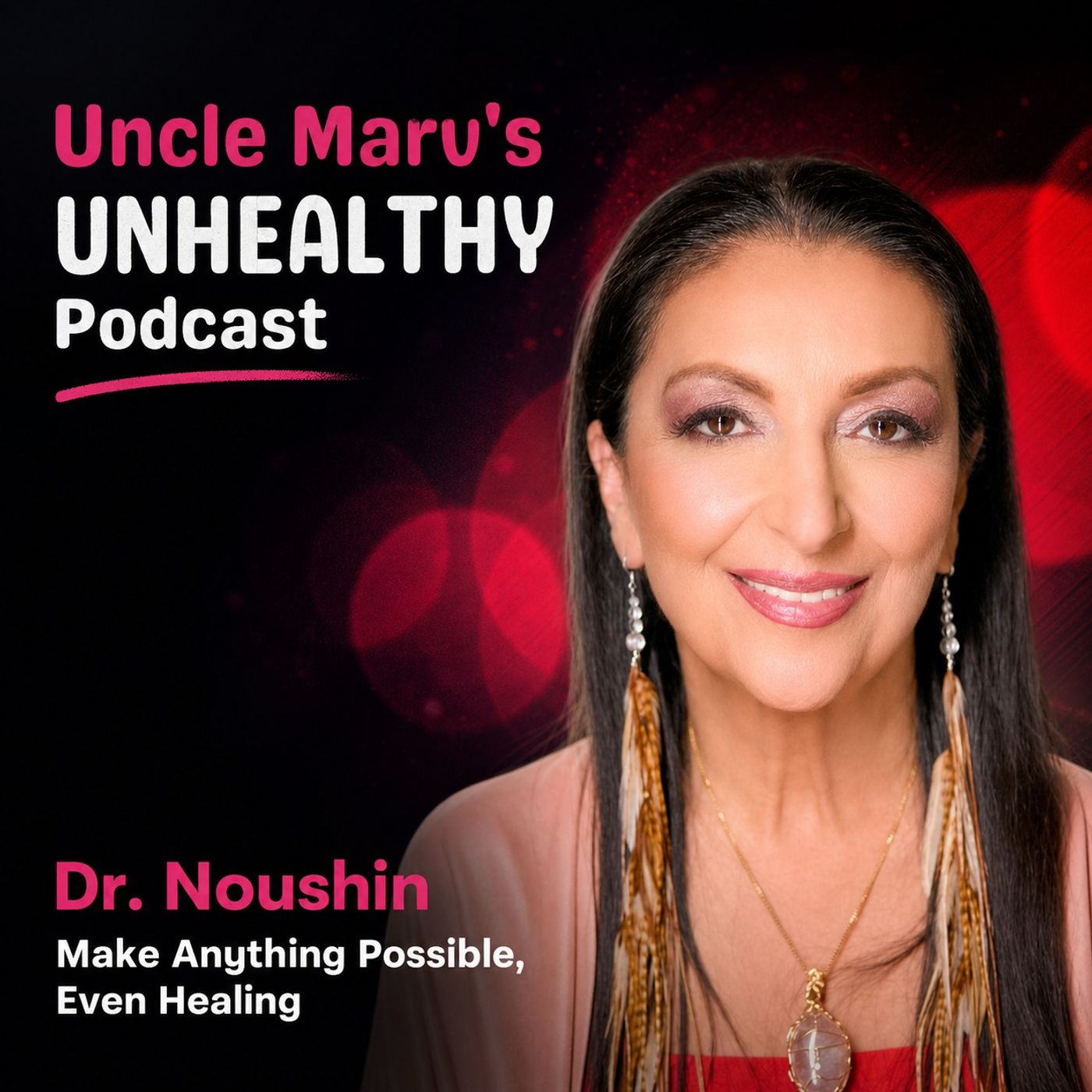
Dr. Noushin Hart opens up about how trauma changed everything she believed about healing, cancer care, and what patients really need. She talks straight about the limits of Western medicine, the power of mindset, and why the whole person matters, not just the diagnosis.


Dr. Noushin Hart’s story is a raw one. She talks about living with hidden trauma for decades, trying to push through with therapy and medication, and eventually hitting a wall where she felt like the usual medical answers had run out. That moment changed how she saw herself, how she saw patients, and how she looked at healing.
What makes this conversation hit hard is that it is not just about cancer care, it is about what happens when people feel dismissed, boxed in, or told their story is already written. Dr. Hart explains why she stopped leading with statistics, why she believes language can shape outcomes, and why trauma, sleep, food, stress, and environment all matter when you are trying to get better.
=== Chapters
- 00:19 Origins of Healing
- 04:01 Breaking Western Medicine
- 07:27 A Life-Saving Turning Point
- 14:24 Hope Beyond Statistics
- 19:11 Kundalini Activation Explained
- 25:15 From Oncologist to Consultant
- 29:25 Whole-Person Cancer Care
- 33:30 Belief and Energy Healing
- 35:57 Hidden Pain Revealed
- 37:35 Rebuilding Daily Health
=== Guest: Dr. Noushin Hart, Healing by Hart
- Website: https://healingbyhart.com/
- Facebook Group: https://www.facebook.com/hart2heartcancerconsultants
- Linktree: https://linktr.ee/dr.hart2heart?lt_utm_source=lt_share_link#547394769
=== MUSIC LICENSE CERTIFICATE: Envato Elements Item
- Item Title: Healthy Eating
- Item URL: https://elements.envato.com/healthy-eating-VNN4M4P
- Author Username: CrazyTunes
- Licensee: Marvin Bee
- Registered Project Name: Unhealthy Podcast
- License Date: January 3rd, 2026
- Item License Code: XPFS6HD54W
=== About the Unhealthy Podcast
Hosted by Marvin Bee (Uncle Marv), the Unhealthy Podcast dives into real conversations about health, wellness, and everyday habits that impact how we live, work, and age. From nutrition myths to stress management and tech-life balance, Uncle Marv brings humor, insight, and honesty to every episode.
- Visit our website: https://www.unhealthypodcast.com/
- Connect on Facebook: https://www.facebook.com/iamunclemarv
- Connect on LinkedIn: https://www.linkedin.com/in/marvinbee/
Follow and Subscribe: Stay updated with new episodes every week on Apple Podcasts, Spotify, YouTube, and more. Join the conversation about real-life health, fitness, and personal growth from the lens of an everyday guy striving to be healthier.
[0:14] Hello friends, Uncle Marv here with another episode of the Unhealthy Podcast.
[0:20] This is the show where we have honest conversations about the habits, the beliefs, and the life events that quietly wreck our health and what it really takes to start turning things around. On this show, we go beyond the quick fixes and the surface level advice. We talk about that messy middle the burnout the bad habits medical diagnoses mental health all the stuff most people would rather avoid but will we all eventually have to face so, my guest today Dr. Noushin hart is an oncologist who spent decades walking alongside cancer patients and their families, and also knows firsthand what it's like to feel completely hopeless and this will be an interesting episode, folks, because if you've paid attention to my show, you know that my family is going through that. So I will try to get through this without tearing up. But without further ado, Dr. Hart, welcome to the show.
[1:21] Thank you. Thanks for having me. I appreciate that. All right. Let me ask this question here, because when we talked previously and as we you do the research and stuff, a lot of what you do seems to be out of the experiences that you had. And so I wanted to ask, would you like to start with that and kind of give people an idea of what that really means? Sure. So by schooling, I'm a radiation oncologist and trained in Western medicine. However, when I was doing my internship.
[2:00] I developed insomnia. And like a good Western medicine doctor, I thought I'd go to a psychiatrist and they give me a pill and they fix me. However, when I went there, they put a question in front of me. I was 35 years old. And for the first time, somebody asked me if I had been sexually abused.
[2:25] And for the first time, I was acknowledging to another human being, yes. But I completely minimized the experience and when the psychiatrist told me that I at least needed seven years of therapy I thought he was crazy I was like why I'm fine I just can't sleep and I said well you can't sleep because of that, and I said you know I can talk about it without absolutely getting upset and say exactly because you suppress all of your emotions you have to talk about them. Those seven years turned into 30 years of therapy, many, many more prescriptions, and I only got worse. And only six years ago, my psychiatrist sat in front of me and told me, I have nothing else to offer you.
[3:17] And I couldn't hear my, I couldn't believe what I was hearing. And even though, thankfully, in rare occasions, I had told my own patients that, that was the first time I was here. And it's very different when you hear it than when you tell somebody else that. I remember it was just like yesterday. I came out of his office and sat on a bench outside of his office. I could not go home. I couldn't imagine going home not knowing what do I do now. And that is when the box of Western medicine broke open and I came out of it.
[4:02] So let me ask just some general questions so that I understand. You were going to see the doctor for insomnia, but they asked you about being sexually assaulted. How did that happen? That's kind of a weird jump that most of us don't understand. I give credit to that psychiatrist that had a comprehensive questionnaire. That was not the only question on the questionnaire. There was a lot of questions. One of the questions was that. And that was the most important question for me because I had kept it a secret for 35 or 31 years old because it started when I was four years old. And for me to acknowledge that to somebody, that was like a breakthrough in a way that I was even acknowledging that, that I felt safe enough to say yes. So that was a breakthrough, but I didn't understand the significance of it. All right. Now, as an oncologist, obviously, you help people go through some of the most traumatic times in life when we're talking about cancer and stuff. How did you get to that point where even though you were hiding what you were going through, what made you want to get into the life area of helping people?
[5:27] You know, Dr. Gabor Matej, who I really, really respect and have worked with him for my own traumas, says something really interesting, that traumatized people, children, when they feel that they have to earn love, They want to be needed. So there's a lot of traumatized people in medicine.
[5:55] Because as doctors, we feel needed. Now, on the surface, I went to, I'm from Iran. And in Iran, there's this culture that if you're a really good student, you have to become doctor.
[6:10] So I was in high school competing with my classmates. I was a very good student. Again, that's a trauma response because you want to show your caregivers that I'm like, really, look at me, like I'm getting top-notch scores and marks. Look how good I am. Please love me and care for me, right? So I was very competitive, really, really top of the class, and I went to medicine. And I was lucky enough that I liked medicine because many of my classmates went to medicine. And I absolutely hated it and they still are doctors and they absolutely hate their jobs but I loved it, but I in Iran when you finish medical school you can practice as a family practitioner without going to residency so I practiced for seven years as a family practitioner, but I got really bored I used to say that if I see one more source road I'm going to jump off the bridge. I need something really challenging that it changes every year and it keeps me on my toes. I have to study every year and things are new and that was oncology. That's why I went into oncology. Okay.
[7:28] So now my question is, you got to the point where you said, what, it was six years ago that your psychiatrist said they had nothing more for you? Right. Okay. Was that...
[7:43] Was that a point where you said, I've got to find something else to help me? Or was that a breakthrough? What exactly did that mean? First of all, when he said that, what I needed to hear was that Western medicine has reached its limit. That is not what I heard. I heard that that was the end of me. Because as a Western doctor, I was thinking the only available treatment is what Western medicine can offer.
[8:12] So the first thing i was thinking i started thinking about taking my own life i couldn't sleep i had panic attacks i was extremely depressed i was miserable i was like i can't live like this right, so then i had a child and my parents were very worried about me and like no i can't do this i can't put my pain on them i have to find a way so i started looking at any modality and for the first time in my life, even though i was a physician i was not asking for data before that's like anybody would talk about any models like where is the data show me the research show me the data now i did not need data it's like here drink a glass of snake oil and you're going to sleep now okay give it to me, so i tried many modalities and they did not help but eventually two modalities showed up in Facebook from all places that literally saved my life and those are the two modalities that now I offer. Okay, now.
[9:22] Are you offering these alongside what you're doing in the oncology, or is this completely separate? Because it sounds like it's not accepted Western medicine, so I'm not sure you can get away with that. I tried to carefully share this with my patients, but my license was at risk. I couldn't really openly talk about it. So I left clinic, and I do this just I.
[9:54] Wanted to be able to because there are many radiation oncologists who can give radiation. There are not many oncologists who offer what I'm offering. Right. Okay. Well, before we get to what those are, I do want to ask a couple of questions because, as you heard me talk about in the opening, you know, my family's going through this where we have a parent that diagnosed with multiple myeloma. We are actually into year five. We're starting to see some signs of decline. And it's weird that people, you know, we don't really talk about that side of the health. You know, we always talk about the medicine. We talk about, You mentioned the pills and, you know, what Western medicine can do, but there's a whole side of hopelessness and communication that doesn't get mentioned. I know that a lot of what you've, you know, had to do is to talk with patients going through cancer as well as their families. So before we talk about what you went through and what you're doing now, what were you doing with people before?
[11:13] You know, before, as a Western-trained medical doctor, I used to give statistics and, you know, they ask about, you know, what is my prognosis? And I give them all these numbers and all of that. And through my own experience, I stopped playing God. I also saw many, many patients who, if you ask me, I would say they're not going to be living for six months and they're still living. And I'm like, we don't know everything, right? And then I also learned about the power of mind, that when you implant something into someone's mind, like, oh, you're going to live six months. That is how long they're going to live because in their mind, they believe and our minds are so, so strong. So I stopped doing that. And even when the patients insisted in knowing, I said, okay, I'll give you those numbers, but first you have to know this is not about you. This is a statistics about other people. This is what happened to other people. This is not about you. I didn't want them to personalize it and then make their minds believe.
[12:31] But if you go against all of these statistics, then your survival is 100%. So very cautiously, I shared those numbers. I never volunteered again.
[12:48] Was there a component that you yourself thought about when, I mean, trying to ask it in a nice way, but what is it that clinicians get wrong, when they're trying to be, and I'm putting this in air quotes, honest with patients.
[13:09] First of all, they believe that science knows everything, and that's not true. Science has studied limited stuff, and there's a lot of stuff that has not been studied. And just because they have not been studied doesn't mean they are not alternatives, right? So it's a good thing that science wants to be careful, wants to be safe. There's a reason we have phase one, two, three studies. But it doesn't mean that there are no other things out there that could be helpful. Now, if we speak within the United States, we also practice very defensive myths. Our liability insurance companies are very careful about what we say and how we say it and when we say it, right? So doctors are also very careful about what they say and what they don't say. So, there are many doctors that are in closet in their own belief system. So, if they're with their family, they may talk about things that they don't talk about with the patients because they consider it liable. Right.
[14:25] So what exactly was the turning point for you?
[14:30] That day. That day? That day was my turning point. And for the first time, I was in the shoes of my own patients. And I was so hopeless and helpless that with that statement from my side practice, that I was like, okay, this is the end of me. There's no hope for me. I'm damaged, good, there's nothing to help me. I either have to live like this forever, or I'm going to kill myself. And then when I was everything completely turned over, off medications, no therapy, sleeping like a baby, no sign of depression, so much joy that I couldn't even imagine. I mean you could call it miracle it was just like a miracle it's like okay well miracles are possible if that happened to me why couldn't that happen to other people right so, one of the one of the modalities i offer is called make anything possible and I m going to borrow that term that everything is possible. Everything is possible. As impossible as it looks, everything is possible.
[15:57] Now, we don't want to give false hope, obviously, and I'm not doing that, but truly, no matter how bad something looks, Thank you. Everything is possible. It may not be likely, but it's really possible. If it happened to me, it could happen to other people too. So this feels like a mindset as opposed to a treatment or something. Is this one of the things that you found? You mentioned two things. Is this the first one?
[16:34] To be optimistic, yes. To become optimistic, yes. And then coming out of that strict box of.
[16:46] Medical definition of what is possible, what is impossible, what is incurable, what is curable, let's not be so strict about them. Let's say, okay, this is what medical science currently can do and cannot do, but don't say that just because medicine doesn't have a treatment for such and such that that patient is incurable. I mean, we have books published by scientists from Harvard Medical School and many other, academic institutions showing a spontaneous healing in patients who never believed, in the death sentence that were given by their doctors. So we are much more powerful than medical science believes we are as human beings. And when we put our mind to it, and when we have this strong desire for one reason or another to live and get better, a lot of possibilities open up.
[18:08] Okay, so that helped you. How are you using that to help others? First of all, the reason that I share my story is even though I am just one anecdotal example, but even one example could be the hope that one person who today is where I was six years ago can look up to and say, well, if she was like that six years ago, maybe I can get better. That's one secondly the two modalities that help me both of them help people at an unconscious level so it's not like therapy that i have to convince somebody, to believe what I m telling them they can be completely in disbelief and these two modalities still help them because they work at a subconscious level.
[19:11] Gotcha. So the first modality is making anything possible. What's the second? The second one is called Kundalini activation process. Okay, you're going to have to help us with that. First of all, the spelling. Yeah, Kundalini is K-U-N-D-A-L-I-N-I. kundalini is life force energy activation process, and it's a modality that basically awakens our dormant life force energy but this life force energy is in all of us, but it's dormant for the most part and with this modality we awaken it and, Putting all the manifestation of it aside, what really happens.
[20:10] Is that our vibration rises. We are all energy. And every thought, every emotion, even our physical state has a certain frequency, certain vibration. And I have learned through this work that the only difference between health and disease is their level of vibration. Disease has a very low vibration level. Health has very high vibration level and that is how spontaneous healing happens. Meaning that when someone with low vibration is suffering from a disease and their vibration level is risen.
[21:01] Now they're healthy because they're not this person with low vibration who had disease. That's how spontaneous healing happens. And with Kundalini activation process, which is a gradual process, it doesn't happen overnight. For me, it happened through many sessions and six years later I'm still doing it because I consider it a form of spiritual hygiene, just as we brush our teeth to keep it clean I want to keep my vibration hot so I do that for myself, and once you raise your vibration you become healthier physically mentally emotionally and spiritually.
[21:52] All right. So when I first heard this and looked it up, I came across similar teachings that basically were referred to as.
[22:04] Tantra and some of the yoga type disciplines. So does this fall into that similar category or is it different? The intention of all of them is activation of kundalini energy, however.
[22:22] There are two major differences between KAP and all other kundalini modalities such as kundalini yoga kundalini breath, KAP is a what we call an ease-based process meaning that you or whoever is practicing that You don't make any effort. When somebody is practicing Kundalini Yoga, they are doing certain movements that is called Kundalini Yoga. Somebody who is doing Kundalini Brat, they're doing certain type of breathing. So the person themselves are making an effort to activate their own Kundalini. With CAP, the person is lying down, closing their eyes in a restful position. And the facilitator like me is playing a playlist that they have prepared a minimum of 60 minutes, maximum 90 minutes. And when we start playing the music, because I have been activated, I get activated and I start transmitting energy to the client. So they are passively receiving this energy from me that activates the Kundalini. So the main difference is that.
[23:46] For them, it's completely effortless. And that results in being 100% safe. Because we human beings, when we want something, we want it yesterday, we watch a movie or video and say, oh, I want what she had. So we have an agenda. And we often push it beyond what our system can handle. With Kundalini activation process, I, as the facilitator, I'm not in charge, the client is not in charge, the energy is in charge, and the energy who is, super intelligent, divine, that is what we call Holy Spirit in Christianity. So the energy knows you very intimately, knows what you need, it doesn't give you what you're asking for, it gives you what you need, and it gives you as much as your system can handle. And because of that, it's 100% safe. It doesn't mean it doesn't sometimes push you into uncomfortable zone. It does because we don't grow in our comfort zone. We have to be pushed a little bit into our discomfort. It definitely brings up traumas.
[25:07] It's a beautiful journey that one has to experience to really understand. Okay.
[25:15] I'm going to ask a horrible transition question go ahead because so when people look up your information in the show notes they're going to see your website heart to heart, cancer consultants answer consultants and they're going to at some point listen to our story and hear okay.
[25:38] Your situation personally wasn't about cancer, but you were an oncologist. So in your understanding these modalities to help yourself, how did you then turn this into cancer consulting? Well, I have had that website for many years, since 2011, Heart to Our Cancer Consultant. And that is really for my oncology expertise. But I have another website called Healing by Heart, and that is for my cap and math. However, since 1940s, there has been published data, which obviously has been suppressed by pharmaceutical companies, with direct connection between unhealed traumas, childhood traumas, and all form of serious illnesses, including cancer. So treating trauma with MAP and CAF is very much my business as an oncologist, because if I don't address traumas in a patient who has gotten cancer, I have only put a band-aid under cancer with treating them with radiation and chemotherapy and surgery. And if I don't address the root cause of it, then the cancer is going to come.
[27:07] So, is this something that, so are you still doing the oncology separate at all? So, no. So, I do second opinion, not in clinic. I can't do hands-on radiation for anybody. But I prefer, if somebody consults me as an oncologist, I talk about the whole person. Like, okay, let's talk about your lifestyle. let's talk about how why did you get cancer and cancer is not a cause and effect disease it's not like even for smokers like they say oh smoking cause cancer no smoking is not a cause and effect why because if it was a cause and effect every smoker should get cancer not every smoker get cancer.
[28:01] And many people who have lung cancer have never smoked. Yes, smoking significantly increases risk of lung cancer, but it's not a cause on that. So we have to look at the whole person. You have to look at the childhood traumas, what they're eating, what water they're drinking, what air they're breathing, what is the exposure to electromagnetic field. You have to look at the whole person, the stress in their life, their relationship. And you have to address all of those. Yes, Western medicine is very good in addressing acute phases of diseases. But once you take care of the acute phase of disease, that is the time to sit down and address the whole person so that, more different types of diseases doesn't show up and the cancer doesn't come back. Okay. So the website we're going to direct people to is healingbyheart.com. And heart is spelled H-A-R-T, just like your last name. And it actually, so it goes beyond cancer. You're actually talking about a lot of different life traumas that you can help people with.
[29:26] So what gets people to look to you when they get to the end of that Western medicine path like you did? How are you able to, or how are people able to find you?
[29:41] You know, people who find me, they find me for different reasons. And not all of them are at the end of Western medicine. Many of them, they have been just diagnosed. And I'm not against a standard treatment by Western medicine. So I tell them, you get your standard treatment, you're probably going to be very busy with radiation chemotherapy and surgery for the next few months or year or whatever. We can, depending on your schedule, we can do it along with your treatment or after those treatments. But I want you to know that your treatment doesn't end with the standard treatment you're receiving radiation chemotherapy surgery we need to get into your entire lifestyle, like i said your traumas and the water you're drinking the food you're eating your, your physical activity the electromagnetic field all of those things needs to be addressed so i have patients who have had cancer they're done with their treatment i have patients who I've been just diagnosed and I have many patients, who have a genetic predisposition for cancer and they want to prevent it. And I'm all for prevention. I love to catch people when they haven't had cancer. Let's talk about prevention.
[31:04] Interesting. So, I remember when we talked, so a lot of this is basically called energy healing.
[31:18] Transition journey, right? You know, I have been an energy healer as a radiation oncologist and didn't know it. Okay, okay. Because when I was getting trained to become a radiation oncologist, all they taught us was physics and different energies we could use for radiation. Like you can use electron, you can use different energies of photon beam, you can use photon beam. This is energy, right? Now, Western medicine doesn't call it energy healing, but radiation therapy is energy healing. Except that we need a multi-million dollar machine to do that. Now with CAP, I don't need any machine. I just use my own body. And with MAP.
[32:09] Because the treatment is done with me connecting to the higher self of my clients, I guess you can call it energy healing, but it's not therapy. There's no talking involved. Nobody needs to tell me any story of what happened to them. It's completely unnecessary. And all I do with muscle testing, I get yes and no from their higher self. And their higher self is healing them. I'm not. I'm just connecting with the higher self. So it's completely painless. 30 years of therapy didn't heal my childhood trauma. Only six sessions of math neutralized my childhood trauma. If that is not a miraculous treatment, I don't know what else to call it.
[33:00] So folks, if you've been following along and you've heard the map and not realize that she's just simply saying, make anything possible, the first modality. So that is what she is talking about. And it's just simply, you know, understanding that these are just limitations that are stepping stones. And you're helping people get beyond that and realize their true potential.
[33:30] But let me ask you this, as somebody who might be listening, thinking, okay, this all sounds interesting. It doesn't sound real. What are some of the misconceptions that people have that you've had to deal with when it comes to energy healing?
[33:50] It all comes from beliefs. Whether it's about our health or whether it's about any particular modality, every one of us has certain beliefs about certain things, right? So as long as we are open to try something and at least for a session or two put our beliefs aside, because as long as, I'm convinced that MAP is not going to work, MAP is not going to work.
[34:26] As long as I'm convinced that CAP is not going to work, CAP is not going to work. Our beliefs are extremely important. So there's nothing wrong with not believing that this or that may not work. When I encountered MAP and CAP in my Facebook from all places after failing Western medicine for 30 years, and after failing, I have written like four pages of modality that I tried and all failed. I was very skeptical. I was very pessimistic. I'm like, yeah, I'm going to try them because there's nothing else to try, but it's going to be like the rest of them. Right. However when i went into it i was miserable enough.
[35:19] That i still have a little bit of hope like hopefully this would work so that little bit of hope was giving me a little bit of an open mind, so as you know in quantum field you can hold two contradictory thoughts i was like No, it's not going to work But I'm hoping it's going to work And they work So as long as, anyone comes with open minds, just try them there's no side effect it doesn't work it doesn't work but you can just try them.
[35:57] So i want to go back and see if we can wrap this up but i want to go back and ask a question because when you talked about getting asked that question well all those questions, with the psychiatrist you mentioned that you had not told anybody for 31 years you were hiding it you never talked about it, but it seemed as though your life was fine until that awakening in a sense. Was your life fine or were there things that were, you know, that caused you to think, I need to get some help? You know, my life was not fine. I had just came out of an abusive marriage that lasted 10 years. And I got a divorce I left my country Because of what was going on in Iran, When my psychiatrist evaluated me He told me that You have been depressed since you were a teenager Nobody made the diagnosis So.
[37:07] For me, not knowing better, I thought I was fine, but I was not fine. And in a sense, the fact that I couldn't sleep kind of opened the door to start investigating and that things were not really fine with me. Okay. Well, that helps me understand now because it puts more perspective on the not being able to sleep. So.
[37:36] How does a good day look for you now? Oh my God. I have, all days are good. I'm a human being and life happens, but I usually wake up without alarm.
[37:54] I usually sleep a minimum of eight hours, sometimes 10, 9, 10 hours. I my sleep hygiene is my priority, and i wake up and i am very much into biohacking i don't know if you know this guy Brian Johnson who spends two million dollars doing research on biohacking i don't have that kind of money but he shares his research of his, uh results of his research for free. So the things that I can do, I do. I'm raw vegan. I exercise every day. I spend at least two hours at the gym every day. I do weightlifting. So I put a lot of emphasis on my own health. I do work, but I'm not a workaholic. I work a few hours a day. Then I enjoy doing the things that I enjoy that I don't even consider work, such as MAP and CAP. And then I do enjoy doing some podcasts, interviews, and things like that. I love traveling. I travel...
[39:01] But I also live a very, very minimalistic and simple life. I remember that I think it was a defense mechanism. I was like a very social person when I was not doing well at all. It's like every weekend was party. I was either at a party or was throwing a party. I could not be alone. I was like always crowd around me. And now I absolutely enjoy being by myself.
[39:33] Because I think for the first time in my life, I love my own company. I love myself. Traumatized people usually don't love themselves. But for the first time in my life, I love myself. And I don't have to be doing things to enjoy life. I just love being. I have become a human being better than a human being. All right. Well, you answered several questions that I was probably set to ask you about what types of things do you do when it comes to map and cap. And you said a lot of stuff there with, you know, being able to sleep, being able to exercise and enjoy life and all of that. I am, I made a note here. I may want to come back to you and ask about the biohacking stuff. That is an area. I'll be honest. I don't. A little skeptical. So I'm not going to lie. I'm not going to say, oh, go get it. I've heard about it and I'm kind of like interested, but.
[40:32] There's simple things like, for example, exposure to sunlight in the morning. That's a biohacking. Sleeping minimum hours, eight hours at night. That's biohacking. I started doing dry sauna every day for a minimum of 20 minutes. That's one of the research that Brian Johnson has done. So it's not anything out of the ordinary, but certain things like not exposing, yourself to blue light of computers, like after a certain hour, like at least an hour before you go to sleep. Simple things. He has published like 40 things that you can do that is free of cost that prolongs your life. That is the type of things that I follow.
[41:20] All right. Well, we may have to have you back to talk about some of that. So thank you very much. Let's do that, yes. Well, Dr. Hart, Dr. Noushin Hart, thank you very much for sharing your story. I know we didn't get too deep into it. I wanted to make sure we talked about the Healing by Heart website and the two modalities, MAP and CAP. The website, folks, will be in the show notes as well as a link. You have a Facebook group, Heart to Heart Cancer Consultants, that is a place for you to go. We've got a link tree. So there's a lot of different places where people can go and find out more about what you're doing. Yeah, you can't avoid me. Just Google my name. All of them come up. All right. Well, Noushin, thank you very much. And we'll go ahead and end off the show here. Folks, if you are still listening, thank you very much. And if you are in the middle of something hard, whether it's cancer, like our family's going through, or it sounds like any sort of chronic illness, depression, or just the weight of life. Looks like you don't have to do it alone. And unhealthy doesn't have to be your permanent story. Check out.
[42:29] Healingbyheart.com and see how Dr. Noushin can help you. Thank you. All right, folks. For more anything unhealthy, be sure to subscribe to the show on your favorite podcast app. If you've got a minute, leave a rating, a review. And the Unhealthy Podcast is produced by me, Uncle Marv. Thank you for hanging out, folks. And remember, awareness is the first step, but action is what changes your story. Until next time, live healthy and be happy.
Hart
Dr. Noushin Izadifar Hart is a Board-Certified Radiation Oncologist whose work bridges conventional
medicine with trauma-informed, holistic, and preventive approaches to health and well-being. She
began her medical education in Iran, graduating in 1986, and practiced as a general practitioner before
relocating to the United States in 1994. She completed her internship at the Medical College of
Pennsylvania in Philadelphia, followed by a residency in Radiation Oncology at Washington University
in St. Louis. For more than three decades, she has served patients across the United States with a
steadfast commitment to excellence, advocacy, and compassionate care.
Throughout her career, Dr. Hart has been deeply committed to helping individuals understand their
bodies, reduce fear around illness, and actively participate in their health. Her clinical experience led
her to recognize that many physical symptoms and chronic conditions are influenced by long-standing
emotional stress, nervous system dysregulation, and lifestyle factors that are often overlooked in
conventional medical settings.
A growing body of scientific research has demonstrated a strong association between adverse
childhood experiences and the development of serious chronic illnesses later in life, including
cardiovascular disease, autoimmune conditions, metabolic disorders, and cancer. Early-life trauma can
dysregulate the stress response system, alter immune and inflammatory pathways, and increase
vulnerability to disease across the lifespan. Dr. Hart integrate… Read More


