Why I Stopped Wearing My Smart Ring (EP 148)
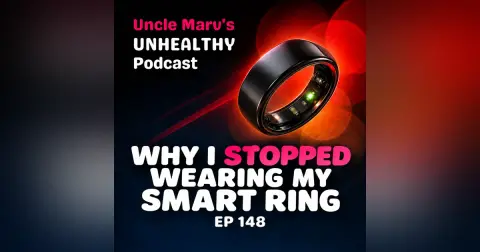


Thanksgiving is behind us, and I'm still recovering. In this solo update, I finally explain why I stopped wearing my RingConn smart ring after almost three months. I also look into a headline that said Thanksgiving dinner might be killing you. The ring gave me some interesting data, but it didn't give me more than the free sleep app on my iPhone. The real reason I quit was simple: I can't wear jewelry.
The headline turned out to be scarier than the science. A study from Indiana University researchers Byungkyu Lee and Brea Perry, published in PNAS, linked difficult people in your close circle to faster biological aging. The effect was modest, it was observational, and it had nothing to do with the turkey. My takeaway is that the best health gadget is the one that helps you make better choices.
=== Chapters
- 01:44 Thank You and the Picky Eating Summit
- 04:04 Why I Bought a Smart Ring
- 06:46 Sleep Tracking: Ring vs Free iPhone App
- 08:19 How to Check a Wearable Before You Buy
- 10:13 What I'll Wear Next
- 12:00 Thanksgiving Dinner Might Be Killing You?
- 13:55 The Hasslers Study Explained
- 15:57 Holiday Weight Gain and Past Episodes
- 19:17 Recap and Holiday Takeaways
=== Products / Resources / Books / Podcasts
- RingConn: https://ringconn.com/
- The Quantified Scientist: https://www.quantified.reviews/
- PNAS study, "Negative social ties as emerging risk factors for accelerated aging": https://www.pnas.org/doi/pdf/10.1073/pnas.2515331123
- Arthur Brooks column, "Thanksgiving Dinner Might Be Killing You": https://www.thefp.com/p/thanksgiving-dinner-might-be-killing-family-happy-politics
- Paige Alexander: Holiday Eating Without the Guilt With Paige Alexander (EP 143)
- Sandi Morse: When Healthy Eating Becomes Unhealthy (EP 145)
- Sofie Knapen: Burnout: When Leaving Is the Stronger Choice (EP 146)
- Teresa Schwarz: The Workout She Actually Shows Up For (EP 139)
- Lena Livinsky: The Picky Eating Summit With Lena Livinsky (EP 137)
=== MUSIC LICENSE CERTIFICATE: Envato Elements Item
- Item Title: Healthy Eating
- Item URL: https://elements.envato.com/healthy-eating-VNN4M4P
- Author Username: CrazyTunes
- Licensee: Marvin Bee
- Registered Project Name: Unhealthy Podcast
- License Date: January 3rd, 2026
- Item License Code: XPFS6HD54W
=== About the Unhealthy Podcast
Hosted by Marvin Bee (Uncle Marv), the Unhealthy Podcast dives into real conversations about health, wellness, and everyday habits that impact how we live, work, and age. From nutrition myths to stress management and tech-life balance, Uncle Marv brings humor, insight, and honesty to every episode.
- Visit our website: https://www.unhealthypodcast.com/
- Connect on Facebook: https://www.facebook.com/iamunclemarv
- Connect on LinkedIn: https://www.linkedin.com/in/marvinbee/
Follow and Subscribe: Stay updated with new episodes every week on Apple Podcasts, Spotify, YouTube, and more. Join the conversation about real-life health, fitness, and personal growth from the lens of an everyday guy striving to be healthier.
Disclaimer
Health information in this episode is for educational purposes only and is not medical advice. Guest experiences and interpretations of genetic, epigenetic, and biological-age testing should not be treated as a diagnosis or an individualized treatment plan. Consult qualified healthcare professionals about personal medical concerns, screening, testing, medications, and changes to your care.
[0:15] Alright, hello everyone, Uncle Marv here, and welcome back to my unhealthy podcast.
[0:22] And Thanksgiving is behind us, unless you're still partaking in all the leftovers, but hopefully you enjoyed the turkey, stuffing, mashed potatoes, gravies, whatever else you managed to pile onto that plate. And if you are anything like me, well, you're still recovering. But we're here, and I've got a couple of things I want to talk about today. Only a couple of items.
[0:50] First, I promised you a while ago that I would tell you the full reasons why I stopped wearing my Rincon. And I did wear it for a longer time than I thought I would. And it tracked my sleep, activity, heart rate, all those things. But I'm going to tell you what happened and what I've done with all of that data since. Second, there was an interesting headline that I read just the other day, actually the day before Thanksgiving, that said, Thanksgiving dinner might be killing you. And I thought, seriously, really? Somebody's going to throw that headline right out there? Can't we just enjoy a holiday meal without somebody telling us we're doing something wrong? But then I decided to look at it and found that there was a study behind it, and I wanted to see if there was actually something behind that headline.
[1:44] So we're going to get into those two stories. But before we do that, I want to say this. Thank you for listening to my show.
[1:54] Sometimes I really don't get, you know, a lot of direct feedback. I can see when people are liking the posts that I put on the Instagram. Sometimes I can see, you know, I can see download numbers in my podcast host, but that doesn't really tell me who's engaging, who's listening and stuff like that. But I did see something when I was looking at the links that I created for the Picky Eating Summit. And if you're not aware of that, my recent guest, Lena Levinsky, I've had her on a couple of times to talk about picky eating and how she came to do this because of her picky eating child, and how it's turned into a pretty big thing that people are following. And she did a virtual summit and, you know, I helped her promote it. And I just put on a couple of affiliate links. Now.
[2:51] I don't expect to get anything from that. It was just simply to help her. But I see that over 70 of you clicked on the links that I created to get the free pass. And then there was also an all access pass where you could pay to get access to a lot of the material for the next year. Now, I don't, like I said, I don't know who did what. I just see that 79 of you clicked on those links. And that tells me that you guys listened and had a little bit of motivation. Now, what it doesn't tell me is if some of you clicked the link twice because, you know, you looked at it one day, decided, yeah, I'm not going to do it. And then you went back another day. But I'm going to assume that most of those are single clicks. And thank you very much.
[3:45] So let's uh let's grab that coffee if you're listening to this in the morning if you're walking whatever settle in let's start talking about living healthier, uh you know without all that health and wellness bs so let's get started.
[4:04] So my first story, of course, the ring con, and I need to remind you all that I purchased this. It's probably, um, coming up on a year, maybe not quite a year, but I got it earlier and I hoped at the time that it would help me kind of look at my health. Everybody had been talking about all their ring gadgets, you know, the Fitbit, the aura ring. And I looked at those and I thought, you know, they seem interesting, but I wasn't going to pay a whole lot of money. And I certainly was not going to do a monthly subscription. So did a little bitty research, looked at all of the stuff out there, including all of the health stuff that you can do on your phone. Now I have an Apple iPhone. It's got a health monitor thing that it can do. And I thought, how's my phone going to track all that stuff, at least with the ring. It's got a couple of sensors on there that would, you know, be able to monitor.
[5:06] Stuff through blood flow and all of that stuff. Now, I really don't know how well it did, but I will say this, I got it and I wore it for, I don't know, almost three months. And of course, like a lot of things in life, the honeymoon fades. And I did do some research as to what other people did with the ring how other people survived and of course there were people that loved it there were people that just literally woke up every day checking their stats obsessively and.
[5:39] That's not what I did. There were people that would skip a day, then a week, and then stop wearing it. I'll be honest, folks, the main reason that I stopped wearing it is because it was uncomfortable. It had nothing to do with the battery life, where some people said that, you know, the battery life started to fade. Some people said that, you know, after a year, it only would last for a couple of days.
[6:06] I think mine was lasting almost a week before I had to charge it up. It was a charger case. And so I would just stick it in the case when I got in the shower and it would be almost at a hundred percent after my shower. So I just charged it up every three or four days. That seemed good for me. Others talked about the idea of having to replace the ring. And of course that took away the idea of no subscription. If you literally had to replace the ring, you know, even if it was every couple of years, you know, at 300 bucks, which the one I got was 299. And there were some that were more expensive. Well, then it kind of feels like a subscription.
[6:46] The other things that people talked about is the main reason that they used it was just simply to track their sleep.
[6:54] Which actually that's what I was doing with a free app on my iPhone that acted as my alarm clock and it would track my sleep. Now, obviously, it wasn't connected to my body, so it could not give me more than that. But I would wake up and it would give me, you know, idea of, you know, the time I went to bed, how I actually slept. It would give me a quality reading. Most of the nights I'm in the 70s, 80s, if I was away at a conference and, you know, went to bed early, I could get in the 90s. But a lot of this was based on the microphone. it would tell you about snoring and stuff the ring con actually did go a little bit different it gave me, an idea that I m probably susceptible to sleep apnea and that i should go check that out but I ll be honest folks it really boiled down to the fact that i, and i don't know when it started it started sometime, high school college when i stopped wearing jewelry all together and then i stopped wearing a watch. And I think that was in college. I'll have to go back and check on that. But I just, I can't wear jewelry. And I mean, so much to the fact that I have lost a lot of rings and I'll leave it at that. But here's the bottom line.
[8:19] Everybody should get what they're comfortable with, and if you're looking at a lot of these rings uh the Fitbit watches and stuff like that do yourself a favor and really check, about the features uh see if there is independent testing on them, uh there is a website uh the qualified scientist that rates a lot of these. They give, you know, real world reveals that talk about, you know, whether you're getting accurate sleep data, a missed sleep apnea, which is what I got. There are false period indications, but of course, all of this should be checked with your doctor. Some of the apps, I'll be honest, the RingConn app wasn't terrible. It was a little cluttery.
[9:13] A lot of people that I, not the people I researched, but a lot of the reviews that I read talked about the apps being cumbersome. And that the features were poorly integrated. And that when there were alerts, they would come, you know, after the fact. And so it was almost like, you know, my body would know things before the alerts would come. And I'll be honest; I didn't set up a lot of the alerts. I'm not an alert person because my daytime job as an IT professional, I get a lot of alerts already. So I try to reduce alerts and I only want them if they're super serious. So that's what I do. so to me to be honest comfort and fit was really what it was I probably have gone so long, not wearing a ring that putting a ring on just didn't work I did it.
[10:13] For a while I would find myself taking it off during the day which would mean setting it aside forgetting to put it back on dropping it all of those things and that just did not work for me so where do i go from here, do i look at the aura the Fitbit air, there's a Garmin that i researched on there or another watch by day a ring by night i don't know what I m going to do but i only know that i needed to give you that full explanation i think i gave you a real quick one, uh just over a month or so ago but I never dedicated time to talk about where I was with that. And I'll be honest, it, sorry about that. I'll be honest, it, I mean, it gave me good information, but it really did not give me any more information in terms of sleep, than the free program on my phone and now the phone is trying to get me to do a subscription to dig more into.
[11:16] You know the analysis and stuff it actually will track um let's see snoring; uh it gives me my sleep history over a certain number of days talks about oh there's wake up phases you can do. There's a lot of stuff you can do. I'm just not going to purchase a subscription for that. So where do I go? I don't know. Where do you go if you were, you know, looking to me for some, you know, sort of guidance or whatever, you got to do what's good for you. But that's my story, folks, and I'm sticking to it.
[12:00] This next story is a headline that i read and thought hmm this is interesting a gentleman by the name of Arthur brooks put out the headline thanksgiving dinner might be killing you, now i have no idea who Arthur brooks was or is, but it's interesting that the story is not about the turkey it's more about the people sitting next to us during those holiday dinners so i did do a little dig into the study and I ll have the link uh, in the show notes about that and the headline is of course scarier than the science so, just a very interesting thing there so here's what i found so the story um ran in a publication, that is called PNAS and i just lost my notes to see where that is but it's a research that comes from a team led by uh.
[13:04] A group of people at Indiana university I cannot pronounce this person's Byungkyu Lee and Brea Perry, uh, the, uh, coauthors. And it was published in an organizational thing called PNAS. Let me look that up real quick because I did.
[13:24] PNAS is Proceedings of the National Academy of Sciences of the United States. I'd never been to this site before, but I went there for this study. So what they did was they studied 2,345 adults across the state of Indiana and took saliva samples. And then from those samples, they estimated each person's biological age using DNA methylation clocks.
[13:55] They also talked about hasslers, and that's in quotation marks. And a hassler is someone in your close circle who often makes it difficult. And about 29% of the people had at least one hassler, and about 10% had two or more. And the actual headliner is that each additional Hassler was linked to roughly 1.5% faster pace of aging, which works out to be about nine months of biological age. So these folks showed more depression, more anxiety, a higher BMI, and chronic conditions. So what the headline skips is that the effect is modest. So the authors compared this to smoking.
[14:55] And it's only a fraction of the gap between smokers and non-smokers second relatives showed the strongest link.
[15:05] But it showed that spouses showed no significant effect. And Hassler's turned out more among parents, children, co-workers, and roommates than among friends or church members. And third, of course, this is observational. The author say that it doesn't prove cause and effect. It's possible aging and poor health make relationships harder not the other way around and then a fourth note, is that in the study it is not about thanksgiving or food, but brooks made the connection himself so the study wasn't about the holiday eating or anything like that this is just what this uh.
[15:57] Arthur Brooks said. On the food side, the classic New England Journal of Medicine, had a study that found that holiday weight gain was under a pound, and the University of Florida Health also points out that gratitude and social bonding can be good for you. So it's a weird little study. Again, I have the link into it, but what's funny is, so Brooks doesn't tell you to cut people off. He says the risk comes from people that you see often and closely, not the once-a-year relative that shows up around the holidays. He does offer research-backed ways to stay connected without letting them drag you down, and this is pretty much his framing. So what I did was, you know, I, I specifically had several episodes on this podcast that I wanted us to talk about, you know, how to eat healthy. Um, I did one with, um, Paige Alexander, where we literally, the title is holiday eating without the guilt. Uh, I had an episode with Sandy Morse when, And, you know, healthy eating becomes unhealthy. So, you know.
[17:17] These are very interesting and then of course if you talk about the mindset behind being around people and whether you have discipline or not uh my recent episode with uh Sofie Knapen uh, talked about you know draining environments poor sleep emotional overload, um that's chronic stress which is you know likely the mechanism that is part of the study that they did. Sandy Morse argued that mental and physical health are connected, and you can't treat one safely without the other. Even my episode with Teresa Schwartz, where she talked about the fact that she needed a trainer to keep her from quitting. Now, that obviously talks about a connection with someone. Now, in her situation, it's not a hassler.
[18:09] But these were things that she called as me times and a way to decompress. Sandy Morse also, if we talk about this from a holiday perspective or healthy eating perspective, in her episode, she talked about labeling fluids as good or bad and that she warned about that because it creates shame. She also said that blood work tells you more than the scale. These are all things that if you go back and listen to these episodes, you'll probably get just as much a clear picture as the study that they did. And again, it, I mean, yeah, it was 2000 people all from the state of Indiana. And I don't know how they correlated what they did from the saliva samples to the number of hasslers that they have, but just an interesting story that I saw and thought, yeah, I'm going to look into this. So I did, and I'll have all the links below in the show notes, and you can tell me what your thoughts are on that.
[19:17] Oh, that is going to do it for my episode this week. I just wanted to do something quick after the holidays. So we talked about the Rincon, folks, why I stopped wearing it, and whether that Thanksgiving feast might be a little harder on our bodies than we realized. Just to recap, the Rincon gave me some good, interesting data, but in the end, it was not a tool that I'll keep wearing, and that's okay. Um the takeaway for you guys should be the best health gadget is the one that actually helps you make better choices the ring con just did not do that for me.
[19:56] Um now that we're heading into the holiday season it's going to mean more parties more food more stress and probably a few more opportunities to get off track, if you are somebody that has hasslers in your life you might want to, think about what you can do to not let them get you off track. But remember, enjoy yourself. Don't feel guilty about having a good time but also don't forget to take care of yourself along the way. But you don't have to be perfect to make healthier choices. All right, folks, that's it. Thank you for spending time with me. I'll be back next week with more health, wellness, and real-life stories. Until then, live healthy and be happy.